Monday, March 4, 2013

Why are Democrats so timid?

Let me start by admitting that's an unfair question. It is NOT the case that "Democrats" are timid. The party is blessed with a number of bold, daring thinkers, unafraid of conservative bluster and willing to take courageous stands in pursuit of social progress. Our President is the most obvious example of such a leader, but others include Nancy Pelosi, Elizabeth Warren and Patty Murray.

This and unlabeled images from Wikimedia Commons

Furthermore, the "timid" charge applies to politicians generally, not to politicians from either party. As David Mayhew points out in his brilliant book Congress, the Electoral Connection, members of Congress are "single minded seekers of re-election". They have to be; the system selects for that behavioral value. Anyone who isn't absolutely focused on the next election loses, usually at the state or local level. Getting elected to Congress is usually the final outcome of a Darwinian process of selection, a career path marked with the defeated campaigns of one's opponents. Politicians who gamble too much lose, and go off to find more lucrative careers elsewhere.

Nevertheless, it is absolutely fair to observe that Democrats in the House and the Senate tend to be be more timid than their Republican colleagues. Their rhetoric is more moderate. Their policies are more incremental. They have a frustrating tendency to adopt the assumptions and narratives of the Beltway press, even when those narratives involve a false equivalence, and attribute a subjectivity to things that are objective, empirical facts.

The most recent example of Democratic chicken-shittedness has been "Dismal" Harry Reid's capitulation on the filibuster. Given the opportunity to reform the filibuster and finally allow    Democrats to legislate, Reid instead opted to preserve the traditions of his beloved Senate. It remains to be seen just how damaging this choice will be for President Obama's policy agenda, but if we get a filibuster of his nominees for the Supreme Court, we'll have Dismal Harry to thank.

Mitch McConnell and Dismal Harry (right) negotiate filibuster reform

Democratic timidity has been a source of intense frustration for many Progressives, going back years. We saw that frustration manifested over the failure of Healthcare Reform to include a public option, the President's tardy enlightenment on Same Sex Marriage and his decision to "surge" in Afghanistan. But it is important to realize that there are reasons for that timidity, and that indeed, timidity is a rational paradigm for people whose guiding motivation is to win their next election.

I have noted elsewhere that the defining characteristic of the American electorate is apathy. Americans (taken as a whole) of this era don't like politics. It bores them. They have only a superficial understanding of their political system. They can't tell you who their elected representatives are, or what positions those representatives have taken on most policy issues. They don't know what their own position is on most policy issues, with any certainty.


But while the average American voter can't recall the name of their Senator, or their Congressman, or (God help us) the Vice-President, they can recognize that name and choose it from a list. A list like, for example, a ballot.

This "recognition" phenomenon explains one of the enduring anomalies of the American political system. Congressional approval rates are lower than David Vitter's morals. The American people regard Congress as corrupt, lazy and completely self-serving. Nevertheless, they continue to vote for them. Incumbent re-election rates were at 90% in 2012. They were at 85% in 2010, commonly portrayed as a "wave" election. We nearly always choose to return the same people we hold in contempt to office, because confronted with a list of names about which we know as little as possible, we select the one we recognize.

It's an odd way for a free people to govern themselves.

The old saying goes, "the only way to lose an election is to get caught with a dead girl or a live boy". There are other ways; anything that gets enough publicity to pierce the willful ignorance of a politician's constituents is dangerous. Keeping a stack of bribe money in your freezer is colorful, it gets lots of press and the voters will hear about it while waiting for the weather on the 11:00 news. An attempted bathroom tryst with an undercover cop is titillating, people don't forget that kind of detail. And a big policy initiative, or a controversial vote, or a deviation from local prejudice or conventional wisdom may have the same effect. Supporting an assault weapons ban won't get as much ink as having an affair with your chief of staff's wife, but it will get some ink, and you can be damned certain your next opponent will try to publicize it.

Adulterer and poster child for Evangelical Christianity John Ensign.

Incumbents thrive on anonymity. Any publicity they seek is of the safe, "I brought you Federal money!" type. They agonize over the tough votes, and pressure their leaders to write legislation to be as uncontroversial as possible. If they keep their heads down, and use their frank to promote name recognition, and don't make anyone in the district too angry, they're a lock to win their next election. They can live in Washington, and make 6 figure salaries, and be wined, and dined, and stroked, and gifted (although they need to be careful about this) and fly to exotic locations on the public dime...

as long as they don't make too many waves.

But that is an explanation of the timidity of politicians. It does not explain the peculiar and institutionalized timidity of Democratic politicians. Political apathy emerged as a dominant value in the electorate in the mid 1950's. As with any complex phenomenon, there are probably many causes. Some of these may be with the gradual replacement of newspapers by television as an evening activity, the rise of consumer values and identity at the expense of community identity, and a broad policy consensus between the two political parties on the basis of support for the Cold War and the existing welfare state as an acceptable status quo. Or maybe not, it's awfully hard to test those hypotheses from the early 21st century.

Liberal Democrat and ardent Cold Warrior Harry Truman

What we do know empirically is that the House of Representatives stopped changing hands. Between 1955 and 1994, Democrats had a majority in the House every single Congress. It was an unbroken hold on power reminiscent of the LDP in Japan or the PRI in Mexico. Democrats controlled the Speakership, the committee chairmanships, the committees themselves. Republicans were limited to the role of a largely symbolic opposition, raising objections from time to time but never exerting any control over the actual process of public policy.

The Senate was nearly the same; Democrats controlled the Senate for the exact same stretch as in the House, with the exception of 6 years under Ronald Reagan. The political timidity that guaranteed reelection for nearly all incumbents also guaranteed Democratic control of the legislative branch. Timidity became ingrained in the culture of the Democratic party more deeply than in the Republican party. Timidity was to the advantage of individual Republican politicians; it was to the advantage of the entire Democratic party, providing them with nearly monopoly control of 1 branch of government, a guaranteed influence over the policy process and domination of that process when they could elect a president, as well.

No strategy is always effective, however. The wave election of 1980 frightened Democrats badly. Not only did they lose control of the Senate for the 1st time in a quarter century, they lost the White House to a candidate who openly challenged the broad policy consensus between the two parties. Ronald Reagan did NOT accept the desirability of the status quo. Rather than the "containment" approach to the Cold War, Reagan was a proponent of "roll-back", the idea that the United States should aggressively attempt regime change in those countries allied to the Soviet Union. He was equally aggressive on "rolling back" the policies of the welfare state, slashing taxes on top wage earners and savaging many programs aimed at the poor.

"Amiable dunce" and national disaster Ronald Reagan. And no, he didn't win the Cold War, either.

And congressional Democrats supinely acquiesced. Democrats were spooked; 1980 was a terrific year for the Republicans, 1982 was just around the corner and opposing the party the electorate had just selected was too much to ask of Democratic politicians who equated controversy with risk. Reagan's entire program was implemented with token opposition, and the Republic suffers from that colossal error to this day.

On the other hand, Democrats held onto the House for another 15 years, so there's that.

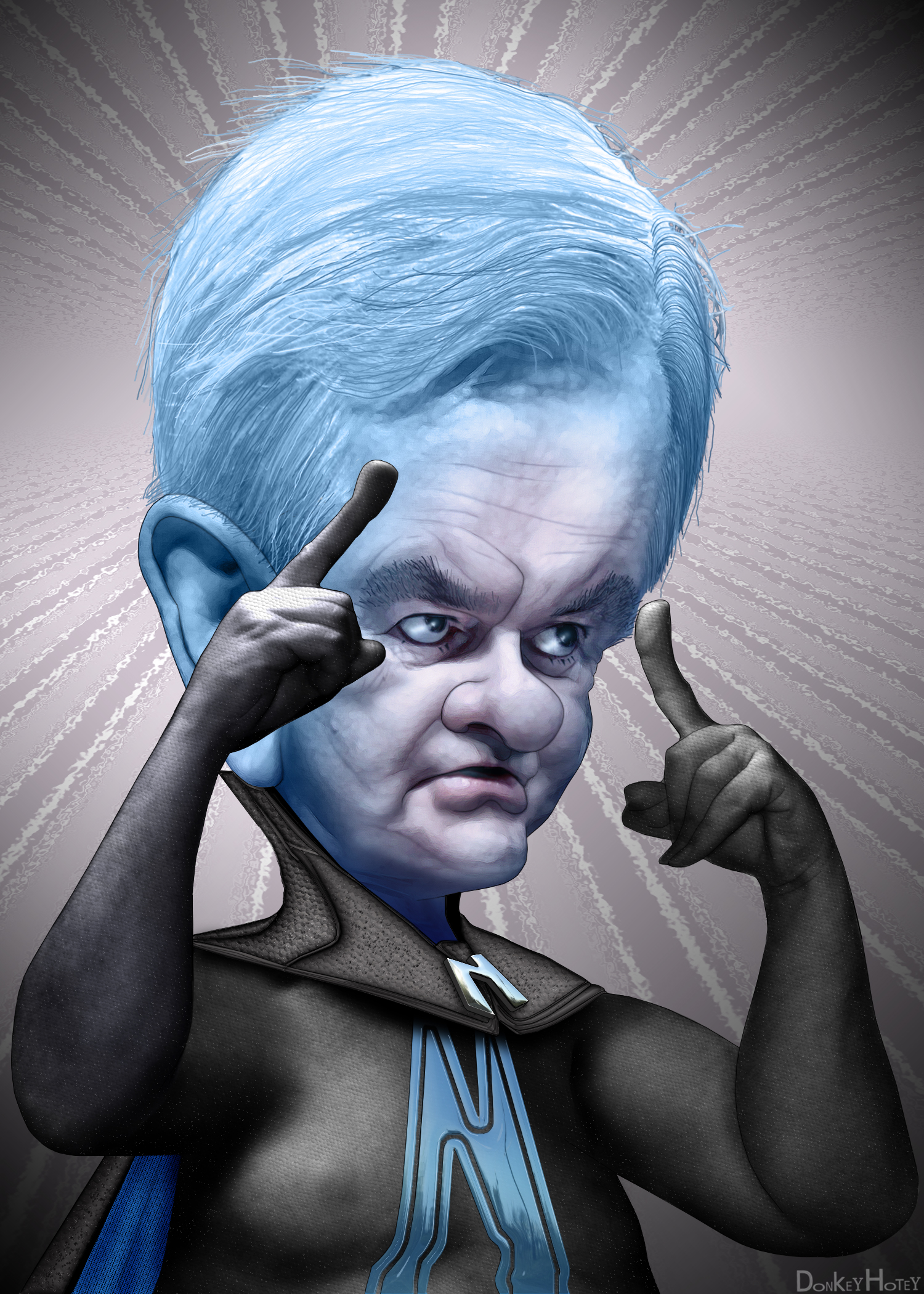
Newt Gingrich ended that string of wins by learning the lesson of Reagan; timidity might serve the interests of individual Republican incumbents taking advantage of an apathetic electorate. But timidity was poison for the party, and for ambitious Republican megalomaniacs who wanted to govern rather than simply quietly enjoy the perks of office. Gingrich's time in office illustrates both the advantages and costs of demagoguery. He broke an historic Democratic monopoly on the House, achieved the Speakership... and promptly destroyed his party's brand with an unpopular government shutdown and a nakedly partisan impeachment.

Controversy is a tactic, Newt. It's not a lifestyle choice

Through the entire conservative realignment initiated by Ronald Reagan, Democrats have assiduously avoided controversy. They're happy to take advantage of Republican missteps, of course. Iran-Contra, Gingrich's own political scandal, the Katrina debacle have all been used to good political effect by Democrats. But Democratic policy can be viewed as an acceptance of the narrative established by Ronald Reagan; government is too big, and incompetent. The financial elite in this country must be given every possible incentive and subsidy or they'll... choose to be less wealthy, and we'll all suffer. We must spend more on defense than the next 14 countries on the list combined.

A jellyfish. Note the striking absence of a spine.

To challenge that narrative would be to court controversy. It would invite charges of being a "tax and spend liberal", or "Washington insider" or "soft on defense". It would risk reelection, and that is something Democratic office holders do not do.

Democratic politicians operating in an electoral environment of pervasive political apathy can count on reelection. An inattentive electorate will cheerfully choose their name off a list of total strangers, as being the one that rings a bell. A secure career of perk and privilege and deference is almost guaranteed after your second term...

if you don't make anyone mad. That value, and the institutional culture which generates it are why Democrats are so timid.

It's an horrendously bad way to govern, however.


Friday, March 1, 2013

The Drone Wars

The insane and dishonest ravings of FOX news not withstanding, President Obama has been a huge disappointment to many on the American Left. (Others of us have by and large been thrilled with his leadership.) His signature health-care reforms did not create a single-payer system. His handling of a structurally corrupt financial sector has been positively deferential. But nothing has enraged the far Left in the way that the President's expansion of the drone war has.


This and unlabeled images from Wikimedia Commons

To a certain extent, criticism of the use of drones is proxy criticism of "The War on Terror". A frequent argument of those opposing the War on Terror is that "terror is a tactic", and that one cannot wage a war against a tactic. And in fact, "terror" IS a tactic.

Terrorism is the intentional use of violence against non-combatants for political purpose.

Some drone strikes are requested by the governments of Pakistan, Yemen or Somalia. Most however, are initiated by American intelligence. The purpose of the unfortunately named "War on Terror", and of the American initiated drone strikes that are a critical part of that war, is not to end "terrorism". The purpose is to prevent terrorist attacks within the United States from being carried out by a specific group of people, described in Fawaz Gerges' masterpiece Journey of the Jihadist. Our target is not every single Muslim fundamentalist. It is not every single terrorist, or every Muslim terrorist. Rather, the targets of the drone strikes are a specific ideological sub-group of jihadists who are ideologically committed to striking "the far enemy", by which they mean the United States.


These people, of whom Al Qaeda is the best known example, believe that their goal of creating an Islamic state, governed on the basis of their peculiar interpretation of the Koran, can never take place while the United States opposes that goal.

They hold the United States responsible for the secular governments in the Arab world, and for the western culture they believe is corrupting muslim societies. They believe that only by directly punishing the United States can they discourage American intervention against them in their struggle to realize their political goals. In the words of Ayman al-Zawahiri:

"The struggle for the establishment of the Islamic State cannot be launched as a regional struggle... we must prepare ourselves for a battle that includes the apostate domestic enemy, and the Jewish-crusader external enemy"


Ayman al-Zawahiri

These groups have demonstrated the capacity and the willingness to kill American non-combatants within the United States. The purpose of the drone strikes is to degrade that capacity and discourage that willingness. This is a much more limited and achievable goal than many drone critics are willing to acknowledge. But there are other objections to the program.

If (as we should) we ignore the unhinged assertions of the 9/11 Truthers who insist the entire War on Terror is based on  a hoax that involved the US government deliberately killing thousands of its own citizens, objections to the use of drones fall into three basic categories: 1) the way in which we use drones is a violation of international law 2) the way in which we use drones is immoral 3) the use of drone strikes is ineffective

Each of these three types of objections: legality, morality and efficacy have several variations, and deserve careful examination.


Journalist and drone critic Jeremy Scahill. This is a thoughtful, talented and patriotic journalist, despite being wrong on this issue.

Are the strikes legal?

The argument that the drone strikes are illegal has several bases. The first of these is that they constitute extra-judicial killings by the United States. Various reputable legal scholars and human rights experts are cited as evidence of this assertion. But an equal number of legal experts insist that the drone strikes are authorized by previous case law and congressional statute. In the absence of a specific legal finding that the strikes are illegal, drone critics are simply expressing an opinion. It is not an established matter of law that the strikes are illegal, Glenn Greenwald's insistence notwithstanding.

A second aspect of the illegality claim involves the "double-tap" tactic of launching a second strike at people involved in rescuing victims of an initial strike. but even critics of the tactic concede,

"A positively identified combatant who provides medical aid to someone amid fighting does not automatically lose his status as a combatant, and may still be legally killed."


There are two key points here that critics of the Drones typically ignore. 1) Combat medics must be clearly identified by insignia, and 2) a person with an AK-47 strapped to their back is a combatant.


Hypocritical self-promoter and outrage merchant Glenn Greenwald. This darling of the far Left supported the Iraq War, and has been trying to re-establish his progressive credentials since.

Finally, critics of the drones claim that the civilian casualties inflicted by drones are a violation of the laws of war. But in fact, the laws of war permit operations which may injure and kill civilians, if such collateral damage is proportional to the military effect of the attack. I will also note that it is a violation of the laws of war to use the presence of civilians to hinder military operations (Article 28). Finally, the actual number of civilian casualties resulting from the strikes is in dispute.

The upper range of civilian casualty estimates comes from The Bureau for Investigative Journalism.  It has published the work of some flakey people. It's methodology is described here

More credible numbers come from the New America Foundation, whose methodology is here. I urge those who insist that large numbers of civilians are being killed in drone attacks to compare the two methodologies for analytical rigor. BIJ, for example, explicitly employs as one source attorneys involved in lawsuits against the United States. NAF by contrast, makes extensive use of the category "unknown" in labeling a casualty as militant or civilian. NAF requires at least two independent sources before they will make that determination.

I should note here that NAF's numbers have been heavily critiqued by the Human Rights Clinic of Columbia Law School. For reasons that completely escape me, this report assumes that any casualty identified by name is "strongly identified as a civilian". I am not a lawyer, nor am I a military analyst. But the rationale for this classification eludes me. The report also relies heavily on BIJ's on site investigations in Waziristan. I am perhaps being unfair when I suggest that going to the site of a drone strike and asking the inhabitants, "Hey! Any terrorists around here?" is a methodology of dubious utility.


Image from Department of Defense. If it disappears, blame the sequester.


Unaddressed in this post is the more limited question of whether drone strikes targeting US citizens are legal. For the sake of completeness, I link the legal rational justifying such strikes here, and the ACLU's response here. As with the question of the general legality of the drone strikes, critics have vastly overstated the objective certainty of their interpretation of the law. 


Are the drone strikes moral?

This is a much trickier question. The morality of any particular act is a subjective judgement made by the viewer. If one accepts (as I do) that the strikes meet the legal test of proportionality, then the morality of the strikes hinges on the morality of killing the intended target of the strike.

One argument against the morality of the strikes is that "we're just as bad as the terrorists". This can be dismissed as facile. The terrorists are intentionally targeting non-combatants. We are accidentally hitting non-combatants while striking legitimate military targets who are hiding among non-combatants. The terrorists who supplied Faisal Shazad with money and training also shot a 14 year old girl in the head for advocating women's education. One can argue that the drone strikes are immoral. But one cannot credibly argue that they are as immoral as the actions of those we seek to kill.


Image of Malala Yousefzai from ABC news

Another is that even if the strikes are proportional, it's immoral to kill civilians. It is absolutely the case that civilian casualties are a foreseeable consequence of the drone strikes. But it is equally the case that civilian casualties, like atrocities, and displacement, and utter, wretched misery are the foreseeable and inevitable consequence of ANY military conflict. A drone strike will kill fewer non-combatants than an air strike. It will kill far fewer non-combatants than an artillery barrage, and exponentially fewer than a pitched battle in an unevacuated area. If civilian casualties mean that drones are immoral, then armed conflict is immoral, and drone opponents need to make their case by identifying themselves as pacifists, rather than simply as drone opponents.

Drone opponents frequently express moral repugnance at the US tactic of striking militant funeralsRevulsion at funeral strikes seems illogical to me. The decision to kill another human being, or group of them is a horrible, bestial, dehumanizing thing. Where one does it is irrelevant, in my view.

In any case, there is a logic to the practice. The death of a prominent jihadist will draw other jihadists seeking to pay their respect to a fallen comrade. They're easy to spot; they're at the head of the procession in the SUVs, surrounded by armed men. I will also note that all of the funeral strikes I have found accounts of are against Pashtun targets. Women do not participate in Pashtun funeral processions, as a matter of custom. This reduces the likelihood of collateral damage, and is perhaps an attempt to address that concern.

Are drone strikes effective?

There are two key arguments used to assert that the drone strikes are ineffective. The first of these is that the United States is simply not killing very many jihadis. I saw this argument made most vehemently by an organization called Global Research, in a post where they asserted that the ratio of civilians to militants killed by drone strikes was 36 to 1. That post now appears to have been scrubbed from their site, which is interesting considering the other dreck they apparently believe. Among the items still up on the site are articles detailing US government attempts to control the weather, 9/11 Truther claims, and assertions that Syria's Bashir al Assad is a victim of Western imperialism who enjoys the support of his people.


I would normally dismiss this particular organization with with a single sentence, or ignore it completely. But somehow that 36 to 1 figure made it into the Twittersphere, and was uncritically accepted by a number of smart progressives that I deeply respect. The debate on the desirability of drone strikes is not improved by the participation of looney conspiracy theorists or devotees of Lyndon LaRouche.

It is a matter of indisputable fact that the top leadership of al Qaeda has been decimated. Top leaders of a number of Taliban factions have been killed as well; we know this because the jihadis themselves acknowledge it in posts on their websites.

Of considerably more concern is the charge that the drone strikes actually strengthen the militants, by causing resentment among the civilian population and serving as a recruitment incentive. A particularly compelling proponent of this view is The Nation's Jeremy Scahill. Drone attacks are cited as a motive for two unsuccessful attacks on US soil by Stanford Law School's International Human Rights and Conflict Resolution study, Living Under Drones (p.136)

What this criticism fails to take into account is the purpose of the strikes; Scahill and others subscribe to the fallacy that this is a war on "terror", or "terrorists". As I stated at the beginning of this post, the purpose of the drone strikes is to disrupt and discourage the proponents of a particular ideological branch within militant Islam. 


A small group of intellectuals within the Islamist movement have concluded that their goals necessitate terrorist attacks within the borders of the United States. They are attempting to plan those attacks. They are attempting to gather financing and material for those attacks and they are attempting to train individuals for those attacks. The presence of drones, the unpredictable nature of the strikes and the lack of effective defenses against drones have made these activities nearly impossible

There is absolutely no question that the drone strikes breed hostility and hatred towards the United States. Some of the people who resent us will no doubt wish to extract some form of revenge against us, although the overwhelming number of them probably simply wish the attacks would stop. But these "new militants" are foot soldiers. They are tribesman who probably don't speak English, lack the resources to strike back and the ability to operate within american borders. Making enemies of these people is regrettable, but infinitely less dangerous than allowing educated, elite members of terrorist organizations to plan their next attack in security.

I believe that drones have become a symbol of the War on Terror. In the minds of many progressives, to approve of the use of drones is to approve of the worst aspects of Bush Administration's execution of the War on Terror, including the use of torture and the unrelated invasion of Iraq. While discussing these issues, I am constantly surprised when people assume that because I don't regard drones as illegal under international law, I must necessarily have supported the invasion of Iraq.

Such views lack nuance. The question of the legality of drone strikes or the efficacy of their use is unrelated to water boarding, or warrantless wire-tapping, or the no-fly list. The conflation of drones with these other issues has led to a kind of intellectual dogmatism more common in political conservatives than progressives. It is simply not the case that drone strikes are self-evidently and objectively illegal. The view that their use is immoral is a subjective view, frequently based in mistaken views regarding the number of civilian casualties they cause. And concerns about their effectiveness are simply concerns, not established and indisputable facts supported by evidence.


Monday, January 28, 2013

Dealing with a Cornered Rat


So here's the good news...

I believe very strongly that the Conservative realignment that began in 1978 with NCPAC has finally run its course. Modern Conservatism, and the GOP which uses that ideology to legitimate its policies are both largely exhausted as forces. Demographic trends have left the GOP with an insoluble dilemma...

no candidate capable of broad national appeal can win the GOP primary process. The party is the captive of those extreme elements it successfully mobilized to achieve realignment in the first place. The base Republican voter doesn't LIKE America, as it is now. And no candidate that doesn't share the Base's disdain for Blacks, or Gays, or Hispanics, or cities, or Liberals, or science can win the party's nomination.


Conservative policies have been further discredited by the performance of George W. Bush in office. Even the most inattentive electorates can be motivated to fire a political party that presided over a series of economic, military and disaster relief failures.

But institutions lag behind the society that create them, sometimes by decades. And the current Republican Party is engaged in a vicious, desperate and ultimately doomed effort to maintain control of those institutions. Somehow, the Republicans intend to continue winning elections despite the unpopularity of their brand.


Their most recent success was the 2010 mid-terms. 2010 was an utter, unmitigated disaster for Democrats. We lost control of the US House of Representatives. We almost lost control of the Senate and would have, had the Republicans not insisted on nominating lunatics for a number of Senate seats they otherwise would have won. Most damagingly, the Republicans took sole control of a number of state legislatures. When the dust settled, the Republicans had complete control of 25 states, with the Democrats controlling only 16.


Image from Sabato's Crystal Ball, at UVA's Center for Politics

This would suck anytime. But for it to have taken place at the beginning of a decade was catastrophic.

The Constitution provides for a national census every 10 years. The number of delegates each state sends to the House is determined by their population, as reported by the census. States also use the same data to draw the boundaries of each Congressional district. These districts must contain approximately equal numbers of voters, in order not to violate the principle of "one person, one vote", at least within the state. (The principle is already violated in the Senate, Electoral College and between states.) 

It wasn't long before our revered Founding Fathers realized that the drawing of both congressional and state legislative boundaries could be done in such a way as to maximize the number of seats held by one political party, and minimize the number of seats held by the dominant party's opponents. The term for this nefarious activity, "gerrymander" is derived from Elbridge Gerry, the 5th Vice President of the United States. Gerry was governor of Massachusetts when that state drew the boundaries of its electoral districts for state and national office in such a way as to maximize the number held by Gerry's party.


This and unlabeled images from Wikimedia Commons

The basic idea behind the gerrymandered district is simple. By concentrating the likely supporters of the opposition party into a few districts where they will constitute a super-majority, one maximizes the number of districts where the opposition will be a minority. Throughout American history, every political party which has succeeded in controlling a state's political institutions has engaged in the practice. No one's hands are clean on this score, not the Democrats and certainly not the Republicans.

It's a horrible, undemocratic process. The purposes of elections in a democracy are to select elites who will make public policy, to hold those elites accountable for the outcome of those policies, and to legitimate the system in the minds of its citizens. The gerrymander undermines each of those objectives by insulating the dominant party from the will of the majority of the voters. 

And this is why 2010 was such a disaster for we Democrats and the country as a whole. Not only was it an ass-whipping of abusive proportions in terms of what happened, it also happened at the worst possible time; right before all those states the GOP had control of drew up the new, gerrymandered congressional and state legislative districts.


And this is not Dwight Eisenhower's Republican Party, although it can be argued that it is the Republican Party of Richard Nixon. This is the Republican Party that led a 30 year conservative realignment of the nation's priorities, away from the New Deal and Great Society and back towards something that resembles the Social Darwinism of the 1920's. This is the party of Lee Atwater and Newt Gingrich and Karl Rove.

Naturally, they don't feel compelled to follow the "rules", especially if those "rules" are an impediment to gaining power. Some of the rules Republicans have broken are actual laws. The US Attorney scandal that cost Alberto Gonzales his job is an example of naked illegality.


Other "rules" were actually conventions, past practice, or precedent. In 2003, the Republicans got control of the Texas State Legislature for the first time in 130 years. Despite the fact that redistricting had already been carried out, the Texas GOP redistricted an unprecedented second time. This cost Democrats 6 seats in the US House which the GOP of course picked up.  The dispute over the legality of this process went all the way to the Supreme Court, which decided states can redistrict whenever they want. And so they're pulling it again, in Virginia.  

It seems like whining to criticize the Republicans for exploiting loopholes in the rules. A case can be made that Democratic outrage at such Republican "dirty tricks" is simply frustration with not having thought of these ploys first. But consider this...

to pass the redistricting measure in the State Senate, they waited till a Democrat was out of the state to attend the President's inauguration. They then sprang the measure, unannounced, during a session of the State Senate on Martin Luther King's birthday.

In the Texas case, Tom Delay got the Department of Homeland security to track the location of Democratic state legislators who were hiding from a quorum call. He also laundered illegal campaign contributions through the RNC.


And mid-term redistricting is just one of a variety of Republican "dirty tricks". Many Americans were shaken out of their catatonic political apathy by GOP efforts to suppress the vote in the last election. Again, I am aware of the tired cliche that "politics ain't beanbag" (obviously coined by someone who's never played beanbag with teen-aged brothers). But if one of our major political parties sees its electoral advantage in having fewer people participate..

well, that has PROFOUND implications for democratic practice.


Image from blog.stylesight.com

I could go on. Current liberal outrage is focused on a number of Republican controlled states that are flirting with the idea of changing the way in which they apportion their Electoral Votes. Most states are "winner take all", with the candidate who wins the popular vote in that state getting all of the Electoral Votes that it casts for the Presidency. Proposals in a number of states, including here in Pennsylvania would divide that state's Electoral Votes between its Congressional Districts. Naturally, the Republican controlled states considering the measure are all reliably Democratic during presidential elections. 

The fact that Republican state officials are willing to dilute their state's influence on the presidency for merely partisan advantage is somewhat shocking. It tells you everything you'll ever need to know about the self-identity and values of those officials. These are GOP partisans, first and foremost. Considerations like democratic representation, political legitimacy, and "fairness" are entirely subordinated to securing partisan advantage.


Compared to their efforts to manipulate elections, the Senate Republican Conference's excessive use of the filibuster seem almost low-key.

Fortunately, there is no need to accept Republican efforts to undermine the popular will in order to eke out a few more dollars for their corporate masters. There are a number of steps Democrats can take to roll back Republican gains which they've attempted to lock in.

The first of these steps is mid-decade redistricting. The Republicans have established the precedent of doing so, and the Supreme Court affirmed it. So any state legislature we regain control of, in 2014, or '16, or 18 can be gerrymandered again. Smart progressives have objected to this idea, as being underhanded or somehow unethical. The Supreme Court disagrees, but in any case...

we don't have to do a partisan gerrymander. Democrats who gain control of their state legislatures need to immediately move to end partisan gerrymandering and replacing their system with a non-partisan districting board. Not only does this end our short-term problem with current Republican gerrymanders, it ends it permanently. Returning to a partisan system is probably very difficult politically. Finally, it allows the Democratic party to support a policy that can be cast as purely a good government initiative.

It should be noted here that Ohio voters turned down a non-partisan redistricting referendum last Fall. I am told by my Ohio dwelling family members (N=6) that the ballot measure was deliberately worded so as to be obscure, and then successfully labeled as incumbent protection by a multi-million dollar campaign.

Another area where Democratic political interests are congruent with good government is in the area of countering Republican voter suppression. Democratically controlled state legislatures should push hard for early voting, weekend voting, more polling places and vote-by-mail. Once the security concerns are addressed, Democrats should push for on-line voting, as well. Republicans represent a decreasing segment of the country's demography; more voters means more Democratic voters. And partisan advantages are the minor consideration here...

the important thing is to encourage as many citizens as possible to participate in their own self-government.


Susan B. Anthony

Finally, there's the Electoral College.

The very fact that we have one of our two political parties attempting to manipulate the Electoral College to give them a better shot at the White House should be all the proof required that the Electoral College is a silly, antiquated practice which has no more place in a modern political system than monarchy. In every single state legislature where such a measure has been introduced, Democrats should introduce competing legislation: The National Popular Vote Interstate Compact.

Then, they should ruthlessly publicize the fact that they've done so. Targeted interviews with state newspapers and local news reporters would begin to familiarize the electorate with the concept. Unions could educate their members, the DNC could fund some TV spots...

and that'd be the end of GOP attempts to game the EC. The EC would be irrelevant, and we'd have a better, more democratic system of government.

Good public policy wins elections. Allowing one political party to manipulate the rules of the electoral system is bad public policy. We can reverse Republican attempts to game the process and get credit for promoting the public interest as well.

Saturday, November 17, 2012

Term Limits are a Terrible Idea

We start with first principles. Just as "politicians are single-minded seekers of reelection", or "Business will attempt to maximize profit"...


the American Electorate is inattentive and apathetic


The average American voter can not tell you the name of their Congressman. They cannot tell you the name of more than one of their Senators. They cannot tell you what bills Congress has passed, nor what bills Congress is working on. And if they have any inkling of the legislative process, it's because they watched Schoolhouse Rock when they were a kid.


However, each of the failings I list above only involve one kind of memory.  That guy who sells the awesome pastries in front of Stamoolis may not be able to RECALL the name of  his congressman, but he can probably RECOGNIZE it, from a list. You know, like a ballot.

Congressman spend inordinate time and effort getting their name in front of their public. They send you mail detailing their legislative achievements and stick the Postal Service with the cost. The mention of a politician's name in the local paper will inspire a round of high fives in their DC office and each of their constituent offices. A mention on the evening news will provoke a round(s) of drinks, especially if a lobbyist can be found to pick up the tab. Members of Congress attend Town Halls, and send congratulatory emails, and walk in parades in an indefatigable effort to pound their name through a dense wall of public indifference, year after year after year...


This and unlabeled images from Wikimedia Commons
It works eventually. Most voters will never have much data on their representatives, but confronted with a choice between two names, most will tend to pick the familiar one, even if it's one they hear just before changing the channel or heading to the bathroom. (Interestingly, some people always pick the name on top.)

Incumbent success rates rise sharply after their first reelection, and more gradually with each successive election. This reflects the progressive effect of candidate self-promotion, term after term, on a disinterested constituency.

I should note here that there are other theories which purport to explain the incumbency effect. And they publish in more prestigious venues than blogspot.

People look at the incumbency effect and think it's a problem. If a Congressman has no statistical risk of losing an election, why would they bother to listen to their constituents? How will new ideas ever get a fair hearing in chambers dominated by aging, electorally invincible old men, committed to the status quo? Congressional approval is at historically low levels, but we can't seem to fire the buffoons we hold in such contempt.


To solve this problem, some people advocate Term LimitsTerm Limits would limit members of Congress to a certain number of terms in office, after which they would be prohibited from running again. This would end the incumbency effect by law.

Term Limits were a popular idea in the 90's. I get the impression (perhaps unfair) that Term Limits advocates don't realize that. A number of state legislatures imposed term limits on their state's DC delegation. These were struck down as unconstitutional; Article I makes each chamber the sole judge of the qualifications of its members. A Constitutional Amendment was started in the House, but it went nowhere. A number of candidates ran for Congress on a promise to term limit themselves...

and most of them promptly reneged on that pledge, once they were in office. 

But it's just as well. In a decade full of bad ideas, Term Limits stand out as particularly dysfunctional.

Image of Beatles tribute band Oasis from Wikimedia Commons.
Consider our system of representative government. Each Senator is elected by a state. Each Congressman is elected by a regional Congressional district. The whole idea is based on geographical representation. People who live in a particular area will choose one of their fellow residents to represent their area's interests in Congress. If you Term Limit their choice, you are exercising influence on the representation of a community TO WHICH YOU DON'T BELONG. 

This has serious implications for democratic governance. Sure, everyone hates Congress, but they keep electing THEIR Congressmen and Senators, at a 90% clip. Term Limits are about telling voters, "You can't have that guy you want, because I think he's been there too long."

There are also reasons to oppose Term Limits that are less theoretical. The single biggest problem faced by our political system is the domination of the mechanisms of government by monied interests. Our regulators are people desperately hoping to end their careers working for the very sectors they regulate. The quality of legal representation available to litigants is a function of that litigant's wealth. And our elected representatives...


are bombarded, every second of the day and night, by lobbyists who want highly technical, obscure, enormously lucrative tweaks to legislation.

The situation is and has always been almost completely outside the public's awareness. This is both because of public inattention and the highly complex nature of the issues involved. Will the economy grow by 3.5 % next year, or 3.2%? Should the Post Office over fund their pension plan? Which proposed depreciation rate will maximize purchases of corporate durable goods in the short term?

The lobbyists are very happy to provide answers to all of these questions, and they hand out free booze every night at parties they throw 7 nights a week. These answers, offered so helpfully and enjoyably, MUST BE CRITICALLY EVALUATED. Someone new to the issues isn't in a position to do that. They don't know the right questions to ask. They haven't learned the nuances of the issues. They lack expertise.

Over the years, as they watch legislation being written, hear testimony in committee, get staff briefings and yes, deal with the unending parade of lobbyists, Congressmen become experts in their fields. They are more savvy, and harder to influence. They figure out who is a bullshit artist, and who is sincerely advocating a position.


Tax Policy expert and former Congressman Dan Rostenkowski. I think he's out of jail, now.
The process is slower in the Senate, where the number of committee assignments makes a member more of a generalist. But it works the same way.

Imposing a Term Limit on an elected representative who continues to enjoy the trust of his constituents deprives those constituents, and the country as a whole, of that person's hard-won expertise. Term Limits guarantee that legislators will be even more dependent upon lobbyists for information and expertise than they already are. Term Limits make the prospect of a long legislative career impossible, and make public service little more than a job interview for the special interest groups. Term Limits take the country farther in the direction of replacing constituent interest with the interests of those who can afford a lobbyist.

Term limits are a terrible idea.